 ENG
ENG
 INA
INA
Strengthening Synergy with the Badung Regency Government, 23 Professors of FVM Udayana to Engage in Village Development in Badung: Promoting Fostered Village Programs and Sustainable Tourism

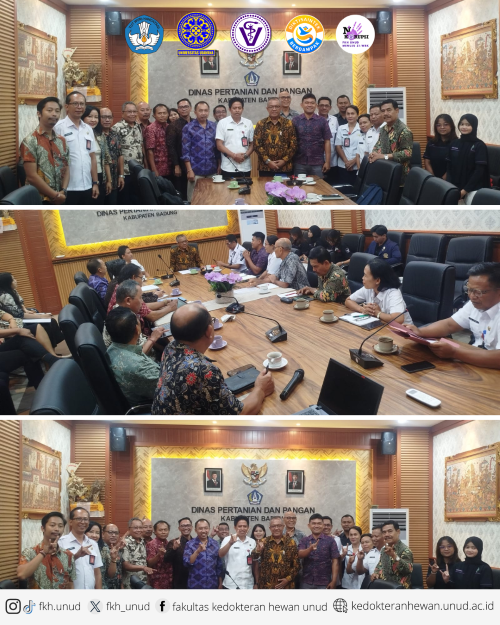
Mangupura, May 13, 2026 – The Faculty of Veterinary Medicine, Udayana University (FVM Udayana), continues to strengthen its commitment to supporting regional development through enhanced cooperation with the Badung Regency Government. In an audience addressed to the Head of the Agriculture and Food Agency of Badung Regency, FVM Udayana proposed various village-based collaborative programs oriented toward sustainable development, public health, food security, and the strengthening of the tourism sector.
This initiative is a follow-up to a previous meeting between the Dean of FVM Udayana and the Regent of Badung regarding plans to develop long-term cooperation between the university and the regional government.
FVM Udayana believes that strong regional development must begin at the village level as the primary foundation of society. Therefore, FVM Udayana promotes the concept of “Building from the Village” through approaches involving education, research, community service, animal health, and the economic empowerment of rural communities.
The program is also aligned with the spirit of “Impactful Campus,” in which universities not only serve as centers of education and research but also actively engage with communities by providing direct solutions and assistance.
As part of this effort, FVM Udayana has also initiated the “Professors Building from the Village” program, which involves the active participation of professors and lecturers in mentoring villages across Badung Regency through practical, solution-oriented, and sustainable academic approaches.
Supported by its extensive resources, including approximately 70 active lecturers, 23 professors, 43 doctoral-qualified lecturers, and more than 1,000 active students from various educational levels, FVM Udayana is optimistic about contributing to the development of the livestock sector, animal health, veterinary public health, food security, zoonotic disease control, and the strengthening of sustainable tourism in Badung Regency.
During the audience, FVM Udayana introduced several programs, one of which is the Rabies and Zoonotic Disease Awareness, Care, and Response Village Program. This initiative aims to increase public awareness in villages regarding the dangers of rabies and other zoonotic diseases through education, vaccination, village cadre training, strengthening animal health surveillance, and the establishment of Rabies Response Villages. Through this program, Badung Regency is expected to become a national pilot region for village-based rabies control.
In addition, FVM Udayana also proposed the Independent and Resilient Animal-Based Food Security Village Program, which focuses on strengthening animal-based food products that are safe, healthy, intact, and halal (ASUH). The program includes support for community livestock farming, livestock health improvement, food safety education, biosecurity strengthening, and the development of village-based livestock MSMEs.
In the tourism sector, FVM Udayana proposed the development of veterinary and livestock educational tourism villages that integrate community livestock potential, environmental sustainability, Balinese culture, and local wisdom values based on Tri Hita Karana. This concept is considered capable of supporting the development of eco-tourism and edu-tourism in line with the direction of sustainable tourism development in Badung Regency.
FVM Udayana also emphasized that animal health, food safety, zoonotic disease control, and the One Health concept play strategic roles in supporting Badung as a healthy, safe, and high-quality world tourism destination. This support is realized through strengthening animal-based food safety for hotels and restaurants, food hygiene education, reinforcement of the ASUH food system, as well as education on animal welfare and biosecurity.
Through this synergy, FVM Udayana hopes to become a key partner of the Badung Regency Government in the development of animal health, food security, education, research, rural community empowerment, and sustainable tourism.
This cooperation is expected to create a regional development model based on collaboration between the regional government, universities, and rural communities that provides real and sustainable impacts for the people of Badung Regency.
Gallery
UDAYANA UNIVERSITY