 ENG
 INA
FVM Unud Aligns the Doctoral Program in Veterinary Science Curriculum with Current Veterinary Needs
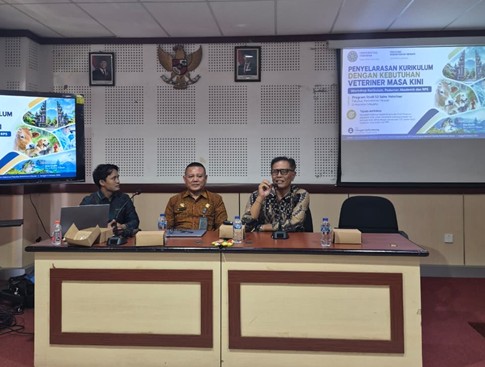
Denpasar, October 2, 2026 — The Faculty of Veterinary Medicine, Udayana University (FVM Unud) held a Workshop on Curriculum, Academic Guidelines, and Semester Learning Plans (RPS) for the Doctoral Program in Veterinary Science. The workshop took place in the 1st Floor Meeting Room of the FVM Unud Building, Denpasar Campus.
The workshop provided an opportunity to review the scientific direction, graduate profile, Graduate Learning Outcomes (CPL), study topics, course structure, and Semester Learning Plans (RPS) of the Doctoral Program in Veterinary Science. The discussion compared the 2024 Academic Guidelines with the 2026 Draft Academic Guidelines as a basis for curriculum alignment.
In the first session, the Head of the Center for Veterinary Disease Investigation, Dr. drh. I Gde Eka Budhiyadnya, M.P., delivered a presentation entitled “Competency Needs for Veterinary Science Doctoral Graduates in Supporting Surveillance, Diagnosis, Research, and National Health Policy.” He outlined several challenges related to animal health and zoonotic diseases that require attention, including transboundary animal diseases, emerging infectious diseases, zoonoses, antimicrobial resistance, climate change, as well as differences in the capacity and commitment of local governments in responding to animal disease outbreaks.
In his presentation, the need for highly qualified human resources at the doctoral level was an important part of the discussion. Graduates of the Doctoral Program in Veterinary Science are expected not only to generate new knowledge, but also to develop methods and technologies, conduct research modeling, and provide scientifically grounded input for animal health policies.
These competencies include predictive surveillance, molecular and innovative diagnostics, continuous research, and the ability to translate research findings into considerations for animal health policy development. The One Health approach is also an important component of these competencies.
In the second session, Prof. Dr. drh. I Nengah Kerta Besung, M.Si., Coordinator of the Doctoral Program in Veterinary Science at FVM Unud, delivered a presentation entitled “Aligning the Curriculum with Current Veterinary Needs.” The discussion focused on aligning the revised scientific direction with Graduate Learning Outcomes (CPL), study topics, course structure, the mapping of CPL to courses, and the development of Semester Learning Plans (RPS).
One of the key aspects discussed was the restructuring of the scientific direction. In the 2026 Draft Academic Guidelines, Veterinary Pathobiology is positioned as the main scientific framework encompassing disease mechanisms, host-agent-environment interactions, and disease epidemiology. The formulation will be further refined to establish a single, concise, and consistent scientific direction.
Meanwhile, the graduate profile of the Doctoral Program in Veterinary Science remains focused on three roles: researcher, educator, and consultant. The Graduate Learning Outcomes (CPL) are being adjusted to broaden the scope of learning to include animal health, veterinary public health, environmental health, infectious and non-infectious diseases, zoonoses, and the conservation of animal genetic resources through the One Health approach.
Alignment is also reflected in the study topics and course structure. Several courses listed in the 2026 Draft include Epidemiology and One Health, Emerging and Re-emerging Diseases, Molecular Pathobiology, Veterinary Biotechnology and Diagnostics, Tropical and Subtropical Zoonotic Diseases, Eco-Tourism Medicine, and Local Genetic Resource Conservation.
In its implementation, the RPS serves as an operational instrument for measuring the achievement of Graduate Learning Outcomes (CPL). The development process follows a continuous sequence from the scientific direction, graduate profile, CPL, study topics, courses, Course Learning Outcomes (CPMK), sub-course learning outcomes (Sub-CPMK), learning materials, and learning methods to assessment. The learning methods promoted include case method, project-based learning, discussions, practical sessions, and integrated research.
The workshop discussion also brought together perspectives from practitioners and representatives of the Center for Veterinary Disease Investigation. Several inputs focused on the need for more applicable research, the use of animal health data as research material, the development of sustainable surveillance systems, and the development of diagnostic kits to support early disease detection.
The discussion also addressed opportunities for collaboration between FVM Unud and the Center for Veterinary Disease Investigation. Available data and resources at the center may be utilized to support student research, with a focus on relevant veterinary needs and challenges.
Dean of FVM Unud, Prof. Dr. drh. I Gusti Ngurah Sudisma, M.Si., in his remarks encouraged stronger collaboration to jointly address animal health challenges in Bali, particularly rabies. He also stated that the vision and mission of the Doctoral Program in Veterinary Science would continue to improve as its development becomes increasingly well structured. Strengthening graduates’ competencies as veterinary practitioners was also highlighted.
Through this workshop, curriculum enhancement is directed toward seven key areas of agreement: establishing a single scientific direction, maintaining the graduate profile, formulating Graduate Learning Outcomes aligned with the scientific direction, determining the structure of core and supporting study topics, establishing the new course structure and list, mapping CPL to courses, and developing Semester Learning Plans aligned with the new curriculum.
The workshop is in line with FVM Unud’s commitment to supporting the Sustainable Development Goals (SDGs), particularly SDG 4: Quality Education, through strengthening and aligning the doctoral education curriculum so that learning, research, and graduate competencies remain responsive to developments and needs in the veterinary field.
The activity also supports SDG 3: Good Health and Well-being, particularly through strengthening competencies in animal health, zoonoses, veterinary public health, surveillance, diagnostics, and the implementation of the One Health approach. In addition, discussions on research development, diagnostic technologies, and veterinary innovation contribute to SDG 9: Industry, Innovation and Infrastructure.
Through continuous curriculum alignment, the Doctoral Program in Veterinary Science at FVM Unud is expected to further develop learning and research that are relevant to animal health, public health, the environment, and emerging veterinary challenges in the field.
Gallery
UDAYANA UNIVERSITY